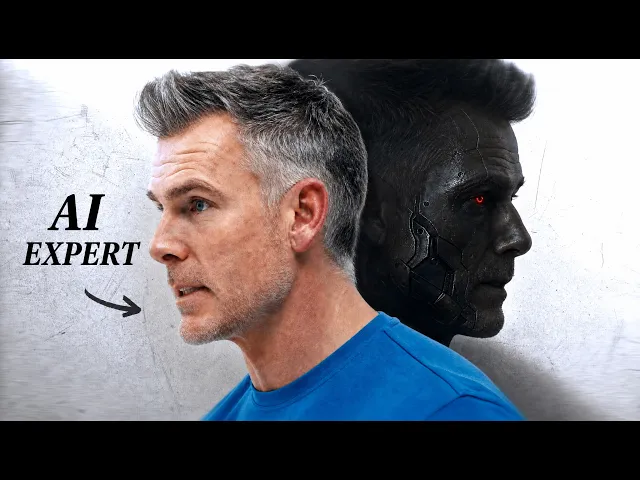
Dan Martell: How to Use AI Better Than 95% of the World
Grant OwenautoenpublicupdatedRead in about 6 minutes instead of watching 73 minutes.
AI Adoption Is Still Early
- Dan says the easiest AI service to sell is content output such as sales pages, websites, sales scripts, blogs, newsletters, tweets, and social media management for people who do not want to learn AI themselves.
- He argues most people are not truly using AI, even if they occasionally chat with ChatGPT, and that only a small minority have paid for AI tools.
- He compares weak AI use to casually talking with a smart cousin, while strong AI use means letting that “genius cousin” do meaningful work and getting out of its way.
Start With Problems, Not Tools
- For beginners, Dan says the first step is not choosing the right technology but identifying the right bottleneck or constraint to solve.
- He uses the theory of constraints to explain that solving the wrong problem wastes effort, while the right move is the minimum effective dose that unlocks the next bottleneck.
- He says many people are overwhelmed by tools, but the real challenge is often learning to let go and allow AI to do the work.
Getting First Customers
- Dan says business is simple: find someone with a problem and ask whether they want it solved, instead of building websites, brands, and social media before finding customers.
- He recommends asking existing contacts whether they know anyone who needs help automating marketing with AI, citing Sarah making thousands after finally doing this.
- He shares that his 12-year-old son used the same approach and sold an AI marketing automation client for $800 per month.
- He says being an excellent employee is much easier than building a business, because entrepreneurship forces people to confront themselves.
Sales And Motivation
- Dan says sales is the best first money-making skill because marketing creates demand but sales converts that demand into clients.
- He defines great sales as asking good questions and having certainty about the future, not being a slick talker.
- He says AI makes it easier than ever to sell and deliver high-quality services if people learn the skill of asking, closing, and enrolling clients.
- For people lacking confidence, he says motivation comes from pain or pleasure, and many people fail to act because their goal is not yet a must.
Partner With AI Daily
- Dan says AI news and model releases are accelerating beyond most people’s ability to comprehend, so people must decide to partner with AI now.
- He recommends making AI part of daily execution, aiming for AI to do 70% or more of the work rather than merely chatting with it.
- He says the future splits between people who create value with AI and people who end up working for AI systems or agents.
- He emphasizes that AI is unique because it can teach people how to use it if they ask it directly.
Future Roles And Skills
- Dan says many roles, including programmers, analysts, project managers, customer service, sales, and bookkeeping, are vulnerable to AI disruption.
- He predicts the emerging role will be the agent operator: someone who configures, manages, and connects AI agents doing the work.
- He argues the most durable human advantages are taste, vision, creativity, risk-taking, and care for people.
- He defines vision as seeing a future that does not yet exist but should, and says AI tends to normalize existing patterns rather than create true innovation.
Scaling A Business With AI
- Dan separates AI income levels: zero to $100K is solving one repeated problem with AI; $100K to $1M is using AI inside the business to grow it.
- His replacement ladder starts with admin work, then delivery, marketing, sales, and finally leadership.
- He says administrative tasks like invoicing, bookkeeping, inbox processing, scheduling, and deliverable coordination should be automated first.
- He says AI can already perform leadership activities such as evaluating status against goals, identifying friction, clarifying priorities, and managing systems.
AI-Run Operations
- Using a gym owner as an example, Dan says AI can manage cleaning, memberships, coaching schedules, maintenance, sales follow-up, SOPs, team training, and expansion planning.
- He says middleman roles are especially exposed because AI reduces information asymmetry.
- He describes an AI COO that manages current locations while also sourcing new locations, checking numbers, preparing bank materials, and coordinating execution.
Upskill Teams
- Dan says leaders must either upskill their teams or replace them, and many layoffs reflect failure to retrain people for AI tools.
- He shut down his company for two days to train the team on AI, Claude Code, terminal workflows, and a hackathon around internal business problems.
- He says the hackathon made the team multiple times more productive and gave the company more capacity with the same people.
- He argues the responsibility for preparing teams for the future is a leadership issue, not a technology issue.
Tools And Workflows
- Dan recommends Whisper Flow as a simple productivity tool because speaking to AI is faster than typing and it transcribes intent rather than every filler phrase.
- He describes using voice prompts to instruct Claude Code across multiple tabs to build reports, dashboards, and internal tools.
- He says AI is the first major technology programmed in English, making it easier to use than traditional coding languages.
- He currently favors Claude Chat, Claude desktop/co-work, the browser extension, and Claude Code, while saying the specific best tool can change quickly.
- He says AI can migrate knowledge, prompts, memories, and workflows from one AI platform to another, reducing dependence on a single tool.
Brand, Trust, And Human Review
- For going from $1M to $10M, Dan says the key is brand because people do not buy AI itself, they buy trust.
- He says brand is built through association, consistent value creation, relationships, and doing what you say over time.
- He warns that AI slop is real and says humans should stay in the loop to review, refine, and approve AI output before it goes forward.
- He updates the 10/80/10 rule by saying AI now does the 80% execution layer, while humans handle direction at the start and quality control at the end.
Final Resource
- Dan offers an AI implementation curriculum he built for his team and children, focused on department-level AI use and principles for avoiding AI slop.
- He says people can message him “AI Grant” on Instagram to receive the internal document.
Actiepunten
- Identify the most important problem or bottleneck before choosing an AI tool.
- Ask existing contacts: “Do you know anybody looking for help automating their marketing with AI?”
- Send that outreach message to every relevant contact in your phone.
- Use AI daily as part of your execution rhythm and force it to do a large share of your work.
- Ask AI directly how to use AI in your business and request ideas.
- Study great work in your field to develop taste, then build vision, creativity, risk-taking, and care.
- Automate admin work first, including inbox processing, scheduling, invoicing, bookkeeping, and deliverable coordination.
- Train your team on AI tools instead of only telling them to use AI.
- Run a focused internal AI training or hackathon around real business problems.
- Use voice input tools like Whisper Flow to prompt AI faster.
- Use AI to migrate prompts, memories, and workflows between AI platforms when switching tools.
- Keep a human in the loop to review, improve, and approve AI-generated work.
- Message Dan Martell “AI Grant” on Instagram to request the AI implementation document.