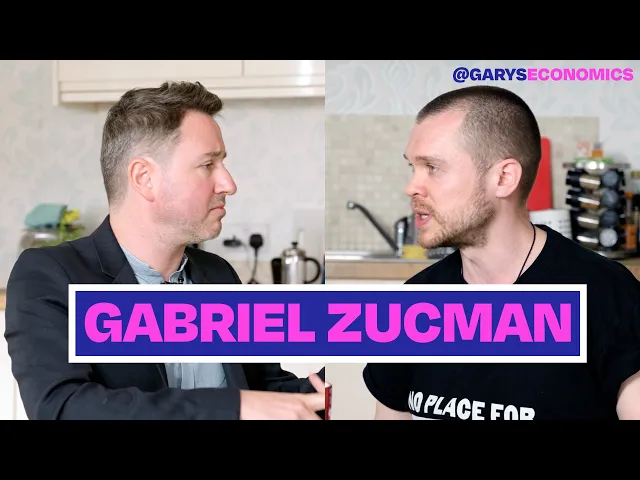
The economist billionaires fear: this is how we get a wealth tax
Garys EconomicsenglishenpublicupdatedRead in about 5 minutes instead of watching 52 minutes.
Introduction to Gabriel Zucman
- The host presents Gabriel Zucman as a leading economist on inequality, billionaire wealth, tax avoidance, and the practical design of wealth taxes.
- Zucman introduces his roles at the Paris School of Economics, UC Berkeley, and the International Tax Observatory, focusing on inequality, multinational tax avoidance, and the taxation of the super rich.
- He argues that billionaire wealth has exploded since the 1980s, accelerated after the 2008 financial crisis, and risen by about 40% globally in the last two years, increasing billionaire political influence.
Why Inequality Became His Focus
- Zucman says living in the San Francisco Bay Area exposed him to extreme inequality, with tech billionaires living near widespread homelessness.
- Trump's 2016 election and the Democratic Party's failure to offer ambitious inequality solutions pushed him toward studying inequality and developing policy responses.
- He sees empirical research, transparency, and data as the foundation for understanding inequality and designing effective public policy.
Inequality in Economics
- Zucman agrees that academic economics long neglected inequality, especially during the Cold War period when efficiency dominated the discipline.
- He says inequality has slowly returned to the center of economics, helped by figures such as Tony Atkinson and the tradition of empirical social science.
- He advises young people who want to study inequality to pursue it and help expand the field from within academia.
Research and Public Debate
- Zucman says social scientists should not only establish facts but also communicate them publicly and propose solutions to social problems.
- He argues that findings about tax evasion and effective tax rates are essential democratic knowledge and should not remain confined to experts.
- He rejects a technocratic approach, saying researchers should feed public debate while citizens decide through democratic deliberation and voting.
- He believes researchers who propose policies should also defend and explain them in public discussion.
The Zucman Tax Proposal
- The proposed tax creates a principle that extremely wealthy people, suggested as those with more than 100 million in wealth, must pay an unavoidable minimum tax each year.
- Zucman argues the minimum must be based on wealth, not taxable income, because billionaires can legally report little or no income while still having enormous economic resources.
- He proposes a 2% minimum tax on wealth as a floor to ensure billionaires pay at least comparable effective tax rates to the rest of the population.
- He says higher rates could be justified, but the 2% proposal is designed as a minimal standard that broad democratic societies should be able to support.
International Momentum
- The proposal was developed in 2024 when Brazil held the G20 presidency and wanted new ideas for international tax cooperation.
- Zucman compares the billionaire minimum tax to the 2021 international minimum tax on multinational companies, arguing a similar principle can apply to the super rich.
- The French National Assembly passed a 2% minimum wealth tax bill in February 2025 for people with more than 100 million euros, though it was later blocked by the Senate.
- He predicts wealth taxation could spread internationally like the progressive income tax did in the early 20th century.
Wealth, Power, and Democracy
- Zucman says the truly radical situation is that the super rich can live in a parallel tax-free society despite benefiting from public infrastructure and collective wealth creation.
- Research across about ten countries shows working and middle classes often pay around 40% to 50% of income in total taxes, while billionaires often pay around 20% to 25%.
- In the UK, he cites the Sunday Times Rich List showing the richest roughly 200 families rising from wealth equal to 5% of GDP in 1989 to about 25% recently.
- He distinguishes middle-class wealth, which provides security, from billionaire wealth, which becomes power over media, markets, politics, and ideology.
- He warns that concentrated wealth creates a feedback loop where wealth produces power, which then produces more wealth, threatening democratic equality.
Making Wealth Taxes Work
- Zucman says past European wealth taxes often failed because they were badly designed with exemptions and deductions that allowed avoidance.
- He argues a modern wealth tax should start at a very high threshold, such as more than 100 million pounds in the UK, and include no exemptions or deductions.
- He estimates this would affect roughly 1,000 UK families and be more effective than older wealth taxes.
- To address tax exile, he proposes that countries continue taxing extremely wealthy long-term residents for several years after they move abroad.
- He says the UK could treat emigrating ultra-wealthy individuals as tax residents for five or ten years after departure, reducing incentives to move solely for tax reasons.
Academic and Public Support
- Zucman rejects the claim that academics do not support billionaire wealth taxation, saying there is broad support among economists and the public.
- He cites a July 2025 Le Monde op-ed supporting the 2% minimum wealth tax, signed by seven Nobel Prize winners.
- He also cites support from economists such as former IMF chief economist Olivier Blanchard.
- He frames the tax as a matter of equality before the law: billionaires should not pay less than nurses, teachers, and ordinary workers.
Final Message
- Zucman says the world is at the beginning of an international movement and needs one country to lead by example on taxing the super rich.
- He estimates a 2% UK tax on the wealth of the super rich could raise about 15 billion pounds per year.
- He argues that if one country proves the policy works, many others will follow quickly.
- The host closes by recommending Zucman's book, We Need to Tax Billionaires, as a short explanation of the practical details behind the proposal.
Actiepunten
- Young people who want to study inequality should pursue it and help build the field within academia.
- A country such as the UK should lead by example by introducing a tax on the super rich and demonstrating that it can raise revenue without catastrophe.
- Rory Stewart should read more about the international evidence and speak with academics who support the billionaire minimum tax proposal.