Open YouTube

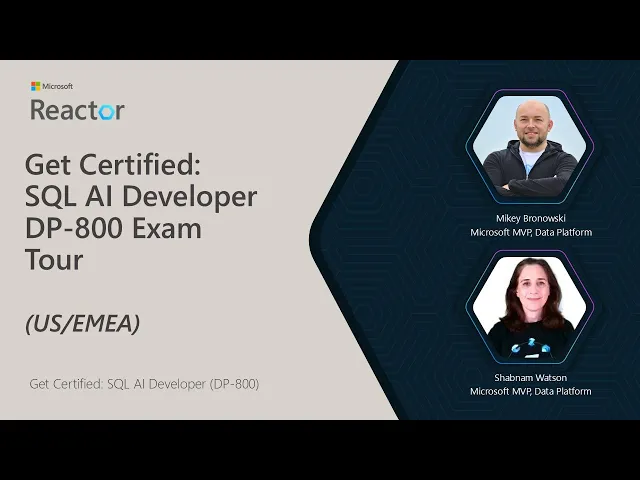
Get Certified: SQL AI Developer DP-800 Exam Tour (US/EMEA)

Microsoft Reactorautoenpublicupdated

Read in about 5 minutes instead of watching 54 minutes.

Session Introduction

  1. The session opens with Microsoft Reactor housekeeping, including the code of conduct, chat moderation, and confirmation that the recording will be available on demand.
  2. Shabana Watson and Mikey Bronowski introduce the DP-800 SQL AI Developer exam tour as the first session in a series intended to help learners prepare for the new certification.
  3. The speakers highlight related community resources, including the SQL user panel, Azure Data user groups, and a future Data Days event that may include DP-800 exam vouchers.

Exam Scope and Domains

  1. DP-800 is positioned for SQL professionals who want to apply AI capabilities across SQL Server, Azure SQL, and SQL databases in Fabric.
  2. The exam covers core SQL development, relational design, structured and semi-structured data, CI/CD practices, AI fundamentals, embeddings, vectors, and model integration.
  3. The three main domains are designing and developing database solutions, securing, optimizing and deploying solutions, and implementing AI features such as semantic search, embeddings, vectors, and RAG patterns.
  4. The speakers advise using the exam domain percentages strategically when planning study time, especially when balancing existing SQL or AI strengths.

Design and Develop Database Solutions

  1. The first domain emphasizes foundational database design, including tables, data types, indexes, temporal tables, ledger tables, graph tables, external tables, and JSON objects.
  2. Sample questions illustrate expected concepts, such as using graph tables for complex relationship traversal and automatic mirroring to synchronize Fabric SQL database changes to OneLake as Delta Parquet files.
  3. Programmability topics include stored procedures, functions, triggers, and views, with focus on when these objects improve maintainability, security, and application integration.
  4. Advanced SQL patterns include CTEs, table expressions, window functions, dynamic SQL, JSON functions, regex, graph queries, and error handling.
  5. AI-assisted authoring covers GitHub Copilot, Copilot in Fabric, instruction files, MCP connections, SQL code generation, code explanation, and harmful-code content filtering.

Secure, Optimize, and Deploy

  1. The second domain covers production readiness, including sensitive data protection, access control, auditing, Always Encrypted, dynamic data masking, row-level security, and immutable blob storage for audit logs.
  2. Performance tuning topics include Query Store, execution plans, dynamic management views, isolation levels, service tiers, resource usage, and troubleshooting changing query behavior over time.
  3. CI/CD with SQL projects focuses on treating database changes like application code through source control, automated builds, schema comparison, drift detection, GitHub pipelines, unit testing, DACPAC deployment, and Data API builder.
  4. Azure integration topics include Azure SQL Database, Azure SQL Managed Instance, SQL Server on Azure VMs, SQL databases in Fabric, hybrid patterns, Key Vault, Azure Monitor, diagnostics, CDC, and Azure Container Apps.
  5. The speakers emphasize that DP-800 is broad and requires deliberate preparation across both basic and advanced SQL areas before attempting the exam.

AI Features in SQL

  1. The AI portion focuses on using SQL data to support AI-enabled applications through native SQL capabilities such as vector data types, external model calls, and natural-language-to-query experiences.
  2. Retrieval augmented generation is explained as a way to ground large language models in an organization’s own data, reducing hallucination by using embeddings stored in SQL environments.
  3. Security remains central when invoking external model endpoints; users need appropriate permissions such as execute external endpoint, and existing SQL permissions still restrict what data they can access.
  4. The session contrasts traditional full-text search with semantic search and vector search, explaining how vectors represent conceptual proximity for AI-driven retrieval.
  5. External models in Azure SQL are described as database objects that store metadata about AI model endpoints rather than models running inside the SQL engine.
  6. Azure SQL stores embeddings using the vector data type, and the speakers recommend hands-on Microsoft Learn tutorials to practice these newer AI and vector concepts.

Preparation and Exam Logistics

  1. Candidates should complete Microsoft Learn modules, use knowledge checks to find gaps, and compare their preparation against the official DP-800 study guide because Learn modules may not cover everything.
  2. The speakers recommend aiming for strong readiness rather than perfection, and scheduling the exam can provide a useful preparation deadline, especially when using a voucher.
  3. During the exam, Microsoft Learn is available inside the exam interface, but candidates should practice navigating it because the timer continues while searching documentation.
  4. Remote exam takers must prepare a quiet room, provide ID, use a clean workspace, avoid reading questions aloud, limit themselves to one screen, and prevent interruptions.
  5. Because the exam was still in beta during the session, candidates taking it at that time would not receive immediate pass or score results until after the beta phase.

Closing Resources

  1. The speakers remind viewers that more sessions in the series will cover the exam topics in greater depth across different time zones.
  2. They again encourage joining the SQL user panel, Azure Data user groups, and Data Days updates to connect with the community and influence Microsoft SQL product direction.
  3. The session closes with thanks to the moderators, producer, speakers, and audience, followed by a request for feedback through the survey link.

Actiepunten

  1. Register for the remaining sessions in the DP-800 SQL AI Developer series.
  2. Join the SQL user panel if your day-to-day work involves SQL and you want to provide feedback to Microsoft product teams.
  3. Join Azure Data user groups, including virtual groups if no local group is convenient.
  4. Register for Data Days updates to learn when the event launches and whether DP-800 exam vouchers become available.
  5. Use the Microsoft Learn module knowledge checks and aim to get them fully correct before attempting the exam.
  6. Practice navigating Microsoft Learn before the exam so you can look up topics efficiently during the timed exam.
  7. Read the official DP-800 study guide and use it to verify that your study plan covers the full exam scope.
  8. Schedule the exam when ready enough to create a concrete preparation deadline, and check the rescheduling policy first.
  9. Prepare your room and notify people nearby before taking the exam remotely to avoid interruptions.
  10. Submit feedback to Microsoft if you encounter a beta exam question whose answer or wording seems unclear.
  11. Complete the post-session survey using the link on screen or in the chat.