
More
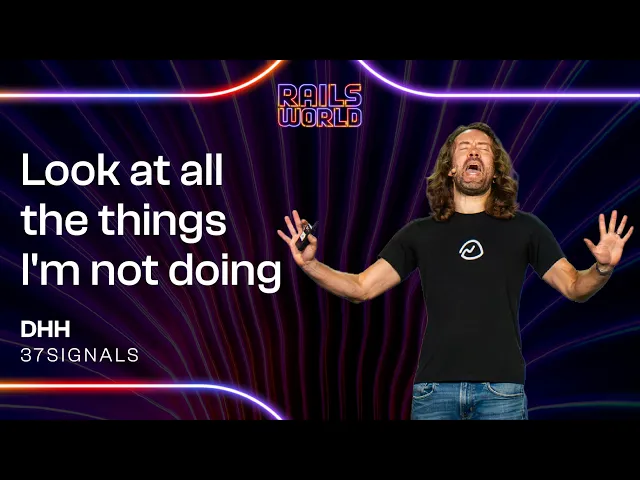
Rails World 2026 Opening Keynote - DHH
Ruby on RailsautoenpublicupdatedRead in about 4 minutes instead of watching 63 minutes.
AI’s inflection point
- DHH describes AI agents as the most exciting—and unsettling—development of his computing career because their ultimate impact remains unpredictable.
- He compares AI-assisted programming to photography’s democratization: cameras displaced portrait painting’s economic role but unleashed new forms of creativity.
- He identifies the November 24, 2025 release of Opus 4.5 as the moment capable software agents became broadly accessible.
- After a brief period of disappointing models, newer systems restored his confidence that frontier intelligence would keep improving and become widely available.
From writing code to directing agents
- DHH argues that the productivity gap between programmers using agents effectively and those working without them may now be hundreds or thousands of times.
- He says he produced half as much code in the past 20 months as during his previous 21 years, largely through agent assistance.
- At 37signals, manually writing code is now treated as an exception; when agents fail, the priority is improving the process that directs them.
- His central question for software organizations is now how to extract the greatest value from rapidly expanding machine intelligence.
- He believes English has become a more expressive programming language than Ruby because developers can specify desired outcomes directly.
- He characterizes his new role not as a professional programmer but as a maker who steers intelligence to create products.
Rebuilding HEY with native apps and Rust
- 37signals is developing six native HEY applications because agents have dramatically reduced the cost of maintaining separate platform-specific codebases.
- DHH predicts that many products built as web apps for economic reasons will move to native applications as development costs approach zero.
- He says agents make languages such as Rust attractive as implementation black boxes, providing speed and efficiency without requiring humans to write or inspect the code.
- The proposed Rust backend for HEY is estimated to use 99% less CPU and 95% less memory, with peak traffic potentially fitting on one Raspberry Pi.
- He recommends assigning agents outcomes or problems asynchronously, then reviewing completed work instead of watching tokens stream in a chat.
Rails in the agent era
- Rails remains well suited to web products that must work without installation, especially for temporary or low-commitment users.
- Convention over configuration improves token efficiency, while Rails’ one-developer philosophy aligns with agents enabling individuals to accomplish far more.
- Rails agent evaluations quickly reached 95% completion, requiring harder tests as model capabilities advanced.
- DHH advises against overly prescriptive prompts: higher-level requests and a beginner’s mindset can produce better results from capable agents.
- Teams will still need to determine which products belong on the web and which justify native applications.
Rethinking software architecture
- Agent-driven development may require reconsidering abstractions because shared abstractions can become bottlenecks when thousands of processes modify software concurrently.
- The traditional cost of duplication and synchronization is falling sharply, changing long-standing architectural trade-offs.
- Software methodologies, development cycles, responsibilities, and specifications must all be rediscovered, with no established blueprint yet.
- Rather than embedding separate chatbots in every product, applications should expose command-line interfaces that users’ own agents can operate.
- Using HEY’s CLI, an agent found an old email from vague conceptual clues that conventional keyword search could not handle.
A new era of making
- DHH presents Omarchy as proof that agents let makers rapidly reshape an entire computing environment around their own ideas.
- Omarchy installation time fell from 3 minutes 33 seconds to 35 seconds on hardware, with a nine-second result achieved in the lab.
- He describes rapidly creating a calculator, writing app, video trimmer, and presentation system without knowing or inspecting their C++ implementations.
- Agent-generated optimization can produce much smaller and faster software because machine effort makes previously uneconomical refinements affordable.
Security, uncertainty, and optimism
- DHH acknowledges legitimate security risks but argues that developers can use the same intelligence to build defenses, isolation, and tools such as HotCell.
- He warns that economic and social predictions around transformative technologies are unreliable, citing employment after ATM adoption as an example.
- His conclusion is that uncertainty should inspire active optimism: programmers should use their expertise to explore, compete, and help define the new industry.
- He urges developers to embrace the transition from hand-written code to directing agents with confidence, energy, and full commitment.
Actiepunten
- Adopt an asynchronous agent workflow: assign outcomes or problems, let agents work independently, and review completed results.
- Use higher-level prompts and avoid prescribing implementation details unnecessarily.
- Add a command-line interface to your application so users can operate it through their own agents; DHH challenges teams to deliver one by next Friday.
- Prepare for AI-related security risks and use available intelligence to build defensive tools and isolation mechanisms.
Transcript
Ask video
Ask Video is a Plus feature
Upgrade to ask questions and get answers linked to exact moments.